
Nike has never been shy about the World Cup, and their Nike World Cup 2026 marketing strategy marks their most ambitious tournament campaign to date. They’ve been a fixture of tournament marketing for decades, building some of the most recognizable sports campaigns in advertising history around the event. But what they’re doing for the 2026 tournament is different in a way that’s worth paying attention to, even if you don’t follow football.
Instead of a single hero campaign that drops around kickoff and rides the tournament’s momentum, Nike has structured a 12-week content and collaboration rollout that began well before the first match and will continue long after the final whistle. The through-line is a rotating cast of global stars, deliberately kept under wraps, and a steady stream of creative work that’s designed to build rather than spike.
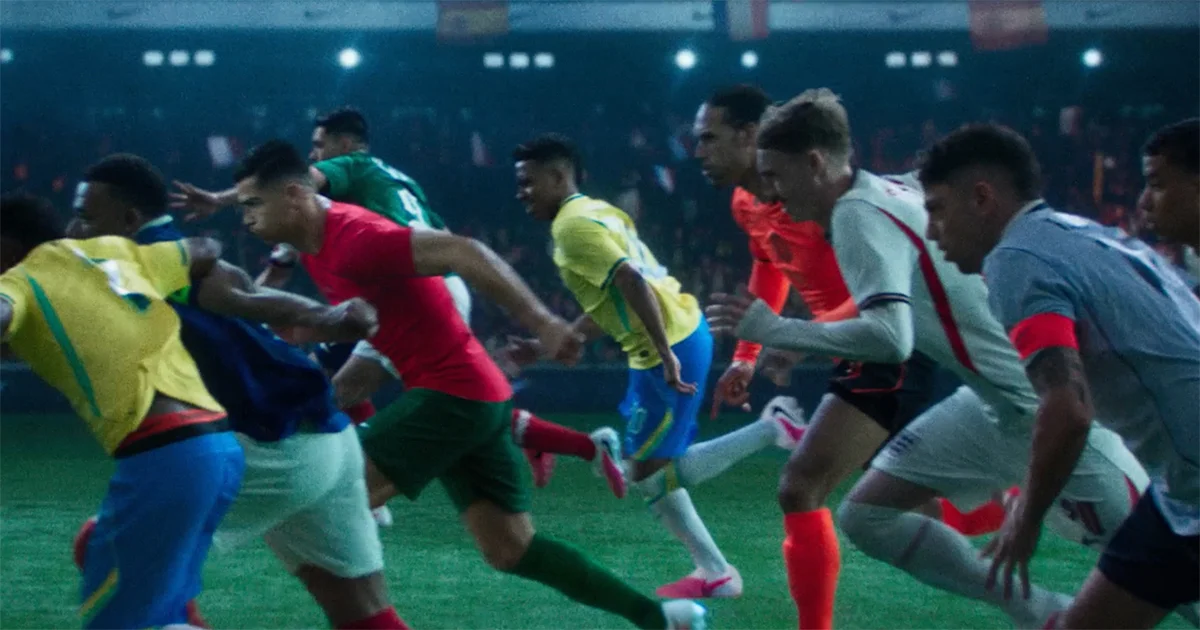
Nike World Cup 2026 Marketing Strategy: 12 Weeks of Sustained Content
The standard World Cup marketing model involves a significant investment in pre-tournament awareness, a burst of activity during the group stage, and a final push around the knockout rounds and final. It’s a proven structure that maps neatly to the tournament calendar, and that’s precisely what makes it predictable.
Nike’s decision to spread the campaign across 12 weeks shifts the dynamic from a moment to a movement. Rather than asking audiences to engage intensely for a few weeks and then move on, the extended rollout keeps the brand present throughout the entire cultural window surrounding the tournament. New collaborations drop regularly, giving audiences a reason to keep paying attention between matches.
This has real implications for how the campaign lives on social media. A traditional launch campaign generates a spike of engagement at release and then decays. A rolling content strategy generates a more sustained baseline of attention, with individual drops creating their own smaller waves. Over 12 weeks, those waves compound in a way that a single campaign launch simply can’t.
The “Surprise Cast” as a Marketing Mechanic
Nike isn’t revealing all the collaborators upfront, and that’s a deliberate choice. The mystery of who’s next creates an anticipation loop that functions like a serialized content strategy, audiences who are curious about the next reveal have a structural reason to stay engaged with the campaign.
This is a mechanic borrowed from entertainment, where episodic reveals and cast announcements generate sustained attention over time rather than demanding it all at once. Applied to brand marketing, it transforms a single campaign into something that functions more like a content platform, a destination audiences return to rather than an interruption they experience once.
The global scope of the cast is equally intentional. The World Cup is uniquely international, drawing passionate audiences from countries that don’t always see themselves reflected in major brand campaigns. A rotating lineup of global stars, drawn from football and beyond, allows Nike to engage with different cultural audiences at different moments throughout the 12 weeks, rather than trying to create a single piece of creative that works everywhere simultaneously.
What This Signals About the Future of Sports Marketing
Sports marketing has traditionally been structured around tentpole moments: the game, the halftime show, the championship. Brands buy in, publish their big creative, and measure the spike. The model works because live sports are still one of the most reliable ways to reach large, engaged audiences in real time.
But that model also has a ceiling. Once everyone is doing essentially the same thing, big campaign, big media spend, big moment, the differentiation has to come from somewhere else. Nike’s approach suggests that “somewhere else” might be time: owning a longer window of the cultural conversation rather than competing for intensity at a single moment.
There are real strategic advantages to this approach. A longer campaign window gives Nike more surface area to generate organic media coverage, each new collaboration drop is its own news moment. It also reduces the risk that comes from concentrating the entire marketing investment in a single creative execution. If one piece of content doesn’t land the way the brand hoped, there are 11 more weeks of opportunity to recover and refocus.
The Content Marketing Dimension
Beyond the campaign mechanics, what Nike is doing reflects a genuine commitment to content marketing at scale. This isn’t advertising dressed up as content, it’s a multi-week editorial strategy with commercial intent built in.
That distinction matters because it affects how audiences relate to what they’re seeing. When content provides genuine entertainment or cultural value, it tends to be shared, discussed, and remembered differently than traditional advertising. Nike has always understood this, their most famous campaigns work as standalone cultural objects, not just as product pitches. The 12-week World Cup strategy extends that principle across an entire tournament cycle.
For brands watching this campaign and wondering whether the approach is replicable, the honest answer is: it depends on the creative infrastructure you have and the audience relationships you’ve built. Nike can execute this because they have decades of athlete relationships, creative capacity, and audience attention to draw on. But the underlying strategic logic, sustain attention over time rather than fight for it at a single moment, is applicable at any scale.
The Nike World Cup 2026 marketing strategy will be studied as a benchmark for how to own a cultural window across a sustained content cycle. For context on how other major brands are approaching the same tournament, see our look at Fox Sports World Cup 2026 coverage and the top marketing campaigns of 2026. The 2026 World Cup will be the biggest sporting event on American soil in decades. Plenty of brands will spend heavily to be part of it. Nike’s bet is that the brands who own the cultural conversation around the tournament, rather than just buying a spot inside it, will come out ahead. Based on their track record, that’s not a bad bet to follow.
